live_tv
Livestream Starting Soon
00
Hours
:
00
Minutes
:
00
Seconds
Up next in 10

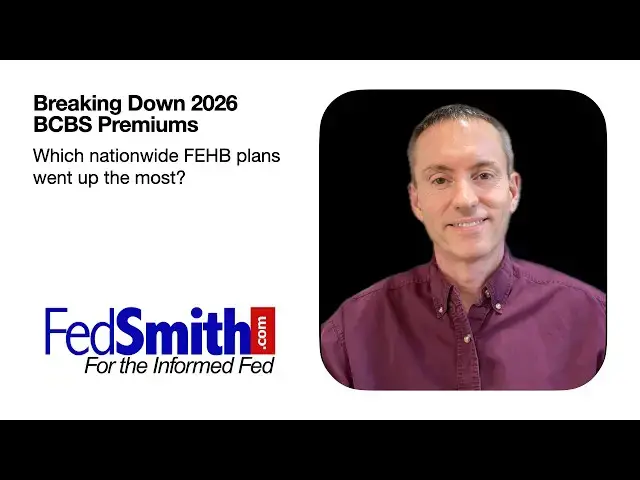
The 2026 Federal Employees Health Benefits (FEHB) Program premiums are increasing by over 10% for the second year in a row. How much are these increases impacting premium increases in one of the most popular programs within the FEHB, the Blue Cross Blue Shield nationwide plans? We go over the numbers in this video, look at what is behind the premium increases, and explain why the FEHB is still a valuable benefit for federal employees and retirees despite the steep premium increases.
Related Articles
Breaking Down 2026 BCBS Premiums: Which Nationwide Plans Cost More?
https://www.fedsmith.com/2025/10/31/breaking-down-2026-bcbs-premiums-which-nationwide-plans-cost-more/
More Expensive But Still Essential: The 2026 FEHB Premiums Story
https://www.fedsmith.com/2025/10/15/2026-fehb-premiums-story/
Why Your FEHB Plan Might Be Costing You Thousands—And How to Fix It
https://www.fedsmith.com/2025/10/14/why-your-fehb-plan-might-be-costing-you-thousands-and-how-to-fix-it/
FEHB Open Season: Health Benefits Mistakes for Federal Employees to Avoid
https://www.fedsmith.com/2025/09/29/fehb-open-season-health-benefits-mistakes-for-federal-employees-to-avoid/
Federal Employees Face 12% Jump in 2026 FEHB Premiums
https://www.fedsmith.com/2025/10/09/federal-employees-face-12-percent-jump-in-2026-fehb-premiums/
FEHB Articles on FedSmith
Show More Show Less View Video Transcript
0:00
Hello everyone. I'm Ian Smith with
0:02
fedsmith.com.
0:04
I'm here today to share with you some
0:06
information about the 2026 federal
0:09
employees health benefits program
0:12
premiums.
0:14
um in particular what's driving the
0:16
increases in the amount of premiums as
0:19
well as the impact of these increases on
0:22
one of the more popular plans within the
0:24
FEP and that's the nationwide Blue Cross
0:28
Blue Shield or BCBS plans. So, let's get
0:31
into it.
0:34
As I'm sure you're well aware, uh it's
0:37
no secret that the cost of health care
0:40
in this country is increasing rapidly.
0:43
And um in the FEB, we've we've seen that
0:47
over the last several years and in the
0:49
last couple of years in particular, the
0:51
FEB has experienced double-digit premium
0:54
increases for two years in a row now.
0:57
Um for the enrollies share of premiums
1:02
the they have experienced a 12.6%
1:06
average increase uh for 2026 and that's
1:09
after a 13.5% average increase last year
1:13
in 2025. Now again that's just for the
1:15
enrolly share of premiums. The total
1:19
average increase in 2026 will be 10.2%
1:22
2% and that factors in the government
1:26
share of the premiums as well, what the
1:27
government pays towards your health
1:29
insurance.
1:32
What's driving these increases? Well,
1:35
this is a list of some of the the likely
1:38
contributing factors. One of them is
1:41
medical cost inflation.
1:43
Hospitals, clinics, and doctors continue
1:46
raising prices to offset higher labor
1:48
and supply costs. Healthc care inflation
1:51
is expected to run roughly twice the
1:54
rate of overall inflation in 2026.
1:57
Prescription drug costs are another
1:59
factor. The increased use of expensive
2:02
specialty drugs, especially new
2:04
treatments for cancer, autoimmune
2:06
disorders, weight loss, to name a few,
2:09
add billions to total program costs.
2:12
Drug spending is the fastest growing
2:14
part of FEB outlays.
2:16
a greater use of health services. Also,
2:19
more frequent medical visits, new
2:21
diagnostic technologies, and expanded
2:23
coverage for behavioral health and
2:25
virtual care services have all increased
2:28
utilization per enrolly.
2:32
And related to that too, we have um an
2:35
aging population in this country and
2:37
that's true within FEB as well, a
2:40
growing with a growing share of retirees
2:43
and older workers. the FEB population
2:46
uses more health care overall and that
2:48
drives up average claims costs.
2:52
Um, plan mix and contribution formulas,
2:56
the government share of FEB premiums is
2:59
capped at 72% of the weighted average
3:01
premium.
3:03
So when more participants shift into
3:05
higher price plans, the government
3:07
contribution increases more slowly than
3:10
total costs and that leaves enrolles to
3:14
cover more of the rising costs. I wanted
3:16
to look at the impact of the increasing
3:19
premiums on the BCBS nationwide plans.
3:24
As I said,
3:26
um there are three plan types offered
3:29
within this. the FEP Blue Focus, the FEP
3:33
Blue Basic and FEB Blue Standard, and
3:36
the FEP Blue website, which is
3:39
FEPblue.org,
3:41
has more information about these plans.
3:44
According to the website, the blue basic
3:47
plan, has been the most popular choice
3:49
within the FB for over 15 years now. I
3:52
put together some tables that illustrate
3:54
the premium increases from 2025 to 2026
3:58
for these uh BCBS plans. The figures
4:04
that I'm including here are for again
4:06
for the enrolly share of premiums only.
4:09
And you can see that among the self plan
4:11
type, the FEP blue basic plan has the
4:14
largest increase.
4:18
In looking at the self and family plan
4:21
type, again, the blue basic plan has the
4:24
largest increase while blue standard has
4:27
the lowest. And I should mention quickly
4:30
also if you find uh that you want to
4:32
study any of these slides in more
4:34
detail, then please pause this video
4:36
during playback if you need more time to
4:38
read them longer. And the self plus one
4:41
plan type, the same is true as well. uh
4:45
it had uh as in the others the the basic
4:49
the FEP basic had the highest increase
4:52
of the the three plans as you can see
4:54
here. Now this last table's a little bit
4:57
different. It provides a breakdown of
5:00
the average increases for each
5:01
enrollment type and plan option from
5:03
2025 to 2026.
5:06
Not surprisingly, Blue Basic had the
5:08
highest average increase again across
5:10
the three plan types. But the average
5:14
increases among the three plan type
5:16
options was pretty evenly distributed.
5:18
As you can see, despite the significant
5:21
annual increases in premiums, the FEB
5:24
program remains a very valuable benefit
5:26
for current and former federal
5:28
employees. And these are a few reasons
5:30
as to why the government contribution I
5:35
mentioned briefly earlier. The federal
5:37
government continues to pay on average
5:40
about 70 to 75% of the total premiums
5:43
which protects enrolles from even higher
5:45
costs. If you go to the OPM website and
5:49
you download the um the premiums for any
5:53
given year, they have spreadsheets that
5:56
detail the costs of each of the plans in
5:59
the FEB and it's broken out by the
6:02
enrolly share, the government share,
6:04
bi-weekly amount, etc.
6:07
And you can see the government's picking
6:09
up a significant portion of those costs.
6:12
I mean, imagine if you had to pay the
6:15
enrollies share plus what the
6:16
government's paying. That would be much
6:19
more expensive. So, so that is a very
6:22
valuable contribution that the
6:24
government's making. Also, the extensive
6:27
number of plans. Enrollies can choose
6:29
from dozens of nationwide and regional
6:31
options during each open season, which
6:35
helps to keep the prices competitive
6:37
over time.
6:39
Um, there's also guaranteed coverage and
6:41
portability. FE FEB offers lifelong
6:44
eligibility into retirement with no
6:46
medical underwriting, a benefit that's
6:48
rarely found in the private sector. and
6:51
the comprehensive benefits. All FEB
6:54
plans include preventative care, mental
6:56
health services, and prescription drug
6:58
coverage, which meet or exceed a the ACA
7:02
standards. That's the Affordable Care
7:04
Act.
7:07
And these are some general tips that can
7:09
be helpful when choosing FEB plans.
7:13
It's important to review your current
7:15
plan and any other available plan
7:17
options available to you each year to
7:19
see what's going to best meet your
7:21
needs. You can eliminate unsuitable
7:24
health insurance plans by checking
7:26
availability and deciding on plan type,
7:29
for example, HMO versus PO. Also, you
7:33
might consider a high deductible plan in
7:36
conjunction with a health savings
7:37
account. That's an HSA for young younger
7:40
healthier individuals.
7:42
whereas a PO or an HMO might be better
7:45
for those with regular medical needs.
7:49
You also want to make sure that your
7:50
desired plan covers your doctors and
7:53
prescriptions. If not, those would
7:55
probably be ones you'd want to end up
7:57
eliminating.
7:59
And also be sure to plan for known costs
8:01
in the coming year. For example, if a
8:04
pregnancy or a surgery that you know
8:07
you're going to have, you want to ensure
8:09
the plan you choose will meet uh your
8:11
medical needs for the coming year. And
8:14
planning advance for any known costs is
8:16
one way to to do that.
8:19
And also remember to use available
8:21
resources.
8:23
Um, one that that you may want to check
8:26
out, uh, the checkbook guide to FEB
8:29
plans is a useful resource. That website
8:32
is checkbook.org. It provides reviews of
8:35
FEB plans. It is a subscription-based
8:38
service. However, some agencies provide
8:41
subscriptions
8:42
for their employees. And the checkbook
8:45
website has a listing of agencies that
8:47
offer access or your agency should be
8:50
able to tell you also if it has a
8:53
subscription available that you can use.
8:55
The OPM website is another good
8:57
resource.
8:59
It has listings of all the FEB plans,
9:02
info and premiums and comparison tools.
9:06
Um,
9:08
and as one other thing to check is the
9:10
insurers's website. I mentioned uh the
9:13
plans that I discussed here today, the
9:16
um the the BCBS plans, the Blue Cross
9:19
Blue Shield. That website was fblue.org
9:22
and it's got a lot of information about
9:24
each of those plans on it.
9:28
Um I've also included links in the
9:30
description below uh to some related
9:33
articles on fedsmith.com that you may
9:35
find helpful. And lastly, just an
9:37
important reminder, the FEB open season
9:40
runs from November 10th to December 8th,
9:44
2025.
9:46
That's coming up very quickly. I'm
9:48
recording this on November 3rd. So,
9:52
federal employees and retirees will have
9:54
the opportunity to choose their federal
9:56
benefits for the 2026 plan year during
10:00
the open season for health, dental,
10:02
vision, and flexible spending account
10:05
benefits during this time. You can visit
10:07
the OPM website for more information.
10:13
So, thank you very much for watching
10:15
today. I hope you found this information
10:17
helpful. And again, I've included some
10:19
links in the description to articles
10:22
with some additional details. Thank you
10:24
and have a good day.
#Health Insurance