


The percentage of federal employees working on site has more than tripled from its low point of the last three years according to new data released by Gallup.
The new Gallup poll data show that as of the second quarter of 2025, 46% of federal employees in Washington, DC now work fully on site. This is more than double the national average of 21% and more than triple the low point of 14% back in Q1 2022.
Also, the percentage of federal employees working in a hybrid model (employees who work both on-site and remotely) dropped sharply since President Trump took office, going from 61% at the end of 2024 to 28% in Q2 2025.
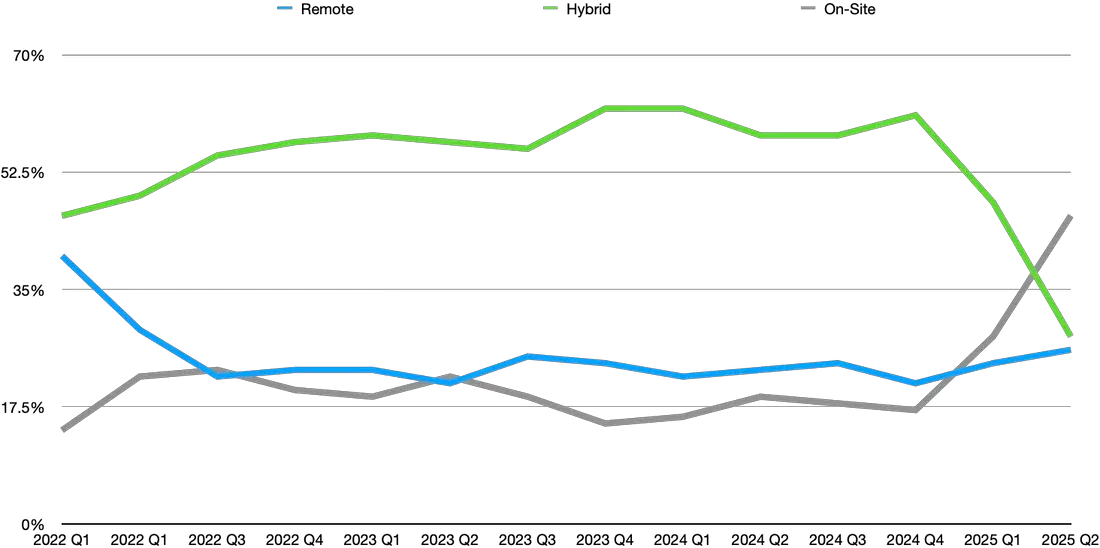
Gallup credits the shift to President Trump’s return to office mandate that he instituted upon taking office earlier this year. That memo, issued on January 20, 2025, stated:
Heads of all departments and agencies in the executive branch of Government shall, as soon as practicable, take all necessary steps to terminate remote work arrangements and require employees to return to work in-person at their respective duty stations on a full-time basis, provided that the department and agency heads shall make exemptions they deem necessary.
History of the Return to Office Requirement
After the president issued his directive, the Office of Personnel Management (OPM) issued guidance to agencies detailing how the return to office mandate was to be implemented. Among OPM’s guidance were instructions to agencies to revise telework agreements, return eligible employees to in-person work, and bring collective bargaining agreements into compliance with the president’s new policy.
The Trump administration presented a choice to federal employees along with the return to office requirement: they could resign with nearly a year’s worth of full pay and benefits or stay and be prepared to work under a different culture and environment than what they had previously.
The deferred resignation program gave federal workers a buyout offer with pay and benefits for the remainder of the government’s current fiscal year, through the end of September 2025. The offer was very explicit; it said that for federal employees who chose to remain in their positions, there would be a “reformed federal workforce” built around four pillars, one of which was the return to office requirement:
Source: OPM
- Return to Office: The substantial majority of federal employees who have been working remotely since Covid will be required to return to their physical offices five days a week. Going forward, we also expect our physical offices to undergo meaningful consolidation and divestitures, potentially resulting in physical office relocations for a number of federal workers.
- Performance culture: The federal workforce should be comprised of the best America has to offer. We will insist on excellence at every level — our performance standards will be updated to reward and promote those that exceed expectations and address in a fair and open way those who do not meet the high standards which the taxpayers of this country have a right to demand.
- More streamlined and flexible workforce: While a few agencies and even branches of the military are likely to see increases in the size of their workforce, the majority of federal agencies are likely to be downsized through restructurings, realignments, and reductions in force. These actions are likely to include the use of furloughs and the reclassification to at-will status for a substantial number of federal employees.
- Enhanced standards of conduct: The federal workforce should be comprised of employees who are reliable, loyal, trustworthy, and who strive for excellence in their daily work. Employees will be subject to enhanced standards of suitability and conduct as we move forward. Employees who engage in unlawful behavior or other misconduct will be prioritized for appropriate investigation and discipline, including termination.
Some federal employees protested the return to office policy. For others who returned to in office work, there were reports of problems they faced shortly after they began doing so, such as having trouble finding parking spaces, office supply shortages, or network connectivity problems.
Many federal employees chose to accept the offer. According to OPM Director Scott Kupor, he expects the federal workforce to shrink by about 300,000 employees by the end of the year, most of whom are resigning voluntarily. Presumably, stripping telework benefits factored into the decision for some of these employees.
Conclusion
Opinions will of course vary on whether the Trump administration’s decision to require federal employees to work on site is beneficial, but the new policy is having the desired effect. The data from Gallup highlight a sharp increase in on-site work among federal employees, particularly in Washington, D.C., alongside a notable decline in hybrid work arrangements.
While the policy has faced resistance and logistical challenges, it has also contributed to a substantial number of voluntary resignations, reshaping the size and structure of the federal workforce. It will be interesting to see how the policy change and its long-term impacts on the federal workforce play out over the next few years.