

Federal Pay From 1970 Through Today
For over five decades, federal employee pay raises have reflected not just economic conditions but also the political philosophies of the presidents in office. The historical data from FedSmith.com and recent policy announcements reveal a nuanced picture of how Republican and Democrat administrations have approached compensation for the federal workforce.
How Average Federal Employee Salary Has Changed
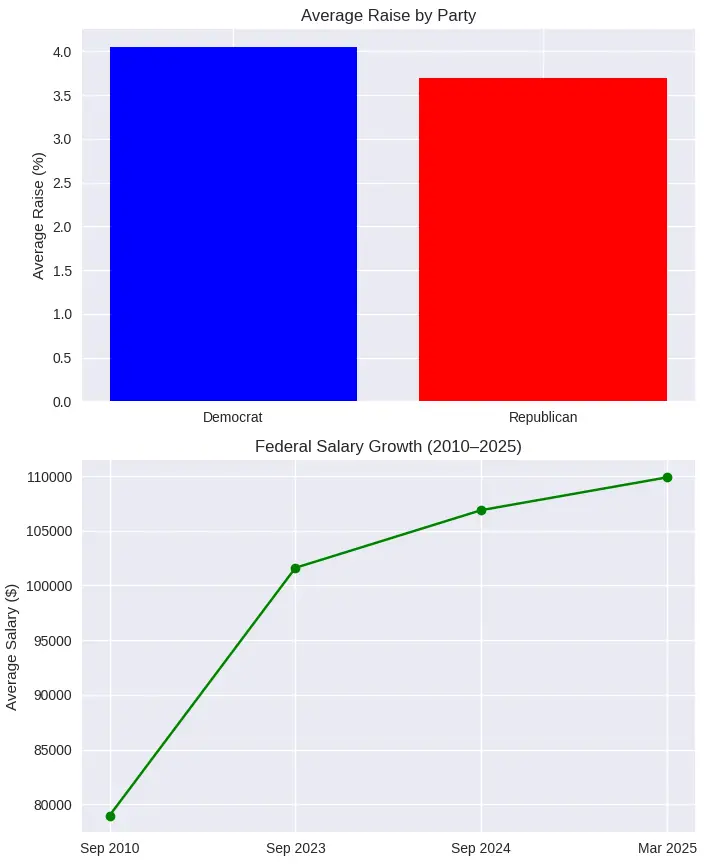
The average federal salary is still going up regardless of the political party of the president sitting in the White House. At the end of March 2025, which is the latest data available, the average salary for the federal workforce (weighted by the number of employees in each age group) was about $109,879, across a total of 2,289,472 employees.
For September 2024, the weighted average salary for the federal workforce was about $106,881, across 2,313,216 employees.
So between September 2024 and March 2025, the overall federal workforce average salary rose from $106,881 → $109,879, an increase of about 2.8%.
For comparison, as of September 30, 2023, the average federal employee salary was $101,610. The average pay between September 2024 and March 2025 went up $8,269 or about 8.14%.
As of September 2010, during the Obama administration, the average federal salary was $78,967. So, the average federal salary increased about 39.2% from September 2010 to March 2025 or an annual growth rate of about 2.34%.
Key Insights from Historical Pay Raise Data
An analysis of federal employee pay raises since 1970 provides a clearer picture of when federal employees have received the largest and smallest raises. Here is what stands out:
| Party | Years in Office | Average Raise (%) | Total Raise (%) |
|---|---|---|---|
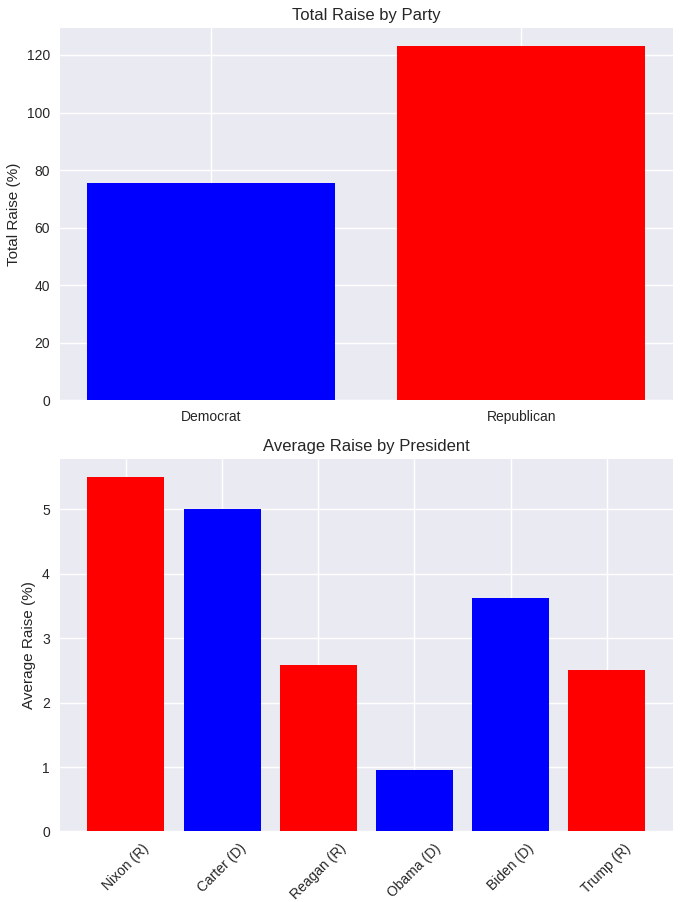
| Democrat | 25 | 4.05 | 75.6 |
| Republican | 31 | 3.70 | 123.1 |
Under which presidents have federal employees received the highest and lowest annual pay raises?
- Highest Average Raise: President Nixon (R) with 6.64% annually.
- Lowest Average Raise: President Obama (D) with 0.96% annually.
- Recent Trend: President Biden (D) averaged 3.63% during his term.
- The raise for 2026 has been proposed at 1% with no locality pay increase and 3.8% for law enforcement officers.
Republican Presidents: Conservative Raises, Occasional Freezes
Republican administrations have generally favored modest raises, often citing fiscal restraint. For example:
- Reagan Era: In the eight years of the Reagan administration, federal pay raises averaged 2.58%, with two years of 0% increases.
- Trump’s First Term: President Trump proposed a pay freeze in three years of his first term, but Congress overrode these proposals to provide raises.
- 2026 Outlook: Trump has proposed a 1% raise for most federal employees and without an increase in locality pay. The proposal also includes a 3.8% increase for some law enforcement officers. Congress could propose a different amount, but has not displayed an inclination to do so.
Despite the lower averages, Republicans have held office longer, resulting in a higher cumulative increase.
Democrat Presidents: More Generous but Widely Varied
Democratic presidents have generally provided higher average raises, though not uniformly:
- Carter: Averaged 6.6%, second only to Nixon.
- Clinton: Delivered steady raises, averaging 3.38%.
- Obama: Instituted a multi-year pay freeze, resulting in the lowest average (0.96%).
- Biden: The four years of the Biden administration reversed the trend with raises of 2.7% 4.6%, 5.2% and 2%.
Context of Highest Raises Given to Federal Employees
What was going on in administrations in which the highest raises were awarded? Here is a quick summary.
Administration of Richard Nixon (Early 1970s – average 6.64% annually)
During the Nixon Administration, the Vietnam War, the expansion of federal programs, and the end of the Bretton Woods system created inflationary pressure.
Nixon supported relatively generous federal raises, both to maintain morale during turbulent times and to counter rising inflation. The timing of Nixon’s generous federal employee raises and the Watergate scandal overlap, but the evidence suggests Watergate itself was nota primary driver of the higher pay increases.
Administration of Jimmy Carter (1980 – 9.1% raise)
During the Carter administration, inflation was soaring (over 13% in 1980), driven by the oil crisis, high energy prices, and economic stagnation (“stagflation”). The Carter administration felt pressure to keep federal salaries competitive with skyrocketing consumer prices. Large raises were partly a response to inflation, more than generosity toward the federal workforce.
Context of Lowest Raises Given to Federal Employees
Administration of Barack Obama (2009–2016 – multiple years of 0% or 1%)
The Great Recession (2008–2009) led to severe budget constraints, high unemployment, and massive federal deficits. Obama froze federal pay for three years as part of deficit-reduction efforts and to show fiscal restraint while negotiating with Republicans in Congress.
Administration of Ronald Reagan (1980s – two years of 0%, average 2.58%)
The early 1980s recession, high interest rates, and efforts to curb inflation through tight monetary policy. President Reagan prioritized tax cuts and defense spending while advocating for smaller government, so federal pay raises took a backseat to these higher priorities.
Other Influencing Factors Across Different Administrations
Politics vary between administrations. This could be politically liberal or conservative philosophies that may dominate.
World events also have a big impact on federal raises. Higher raises often happened when inflation was high (Carter, Nixon, Biden), but the “real” benefit was often erased by rising prices.
Overall national deficits and federal budgets can also play a deciding role. During times of deficit-cutting (Obama, Reagan, Clinton to some extent), raises were suppressed or frozen.
Democratic administrations often had union backing but still limited raises when fiscal pressures were high, whereas some Republican presidents approved higher raises to counter inflation or maintain competitiveness.
Sometimes Congress acted to increase (or reduce) raises regardless of presidential proposals, though presidents usually had the decisive influence.
Where Federal Employees Fared Better
Republicans have been in office for more years than Democrats since 1970. This means that federal pay has accumulated more when Republican presidents were in office. That does not tell the whole picture though. Under President Nixon, a Republican, federal pay had the highest average increase. And, under President Obama, a Democrat, federal pay had the lowest annual increase.
- Short-Term Gains: Federal employees saw higher average raises under Democratic presidents.
- Long-Term Totals: Republicans delivered a greater cumulative increase due to longer tenure.
- Best Years: The Nixon and Carter administrations stand out for their generous increases.
- Worst Years: The Reagan and Obama years saw the most stagnation.
Conclusion: Pay Raises Reflect Political Priorities
Federal pay raises are more than numbers—they reflect the priorities of each administration centered around the size of government, fiscal policy, and workforce value. While Democrats have tended to offer higher annual raises, Republicans have delivered more over time due to longer control of the White House.
For federal employees, the party in power can make a tangible difference in their paycheck.