

We all know what trust is. There is no need for someone to explain to us what the word trust means. If you don’t know, you can look it up in the dictionary and find a definition that someone wrote to explain what it means.
But do we really need a dictionary to explain trust, or is it something we instinctively understand? The dictionary may standardize the meaning of the word, but does the dictionary standardize our personal understanding of what trust means to each of us?
Trust has so many different applications. Right now, think about how many ways and to how many relationships you apply your personal understanding of what trust means to you. There are so many relationships which require trust that sometimes we forget all the trust needs we have.
Trust and Relationships
Let us look at a brief list of relationships where you have developed your own personal understanding of whether you have trust. We are going to divide trust into two categories – trust of people and trust of organizations.
Let us start with some examples of trust in people. By no means is this list exhaustive of trusting relationships between people.
Trust in people:
- The relationship between spouses
- The relationship between significant others
- The relationship between parents and children
- The relationships between siblings
- The relationship between co-workers
- The relationship between employees and their various levels of supervision
- The relationship between supervisors and higher-level supervisors
- The relationship between employees and the overall head of the organizations
- The relationship between employees and the organization they work for
- The relationship between employees and people the employees provide services to
- The relationship between people and their neighbors
- The relationship between you and your children’s caregiver
This list could go on for many more categories of your interactions where you must have trust in people.
Sometimes what we trust are organizations and not just specific people. Let us look at some of these relationships:
Trust in Organizations:
- Do you trust your bank to ensure that your money will always be safe?
- Do you trust your grocery store to provide safe food?
- Do you trust the train or bus you take to work every day to get you to work safely?
- Do you trust that your medical care provider will provide the level of care necessary for your well-being?
- Do you trust organizations that provide activities for your children?
- Do you trust your source for news?
This list could go on with more relationships you have but have never realized that in interacting with these organizations you must have a certain level of trust in the organization.
Trust may be situational, transactional, or all-encompassing. As an example, you may trust your spouse with respect to certain things but not all things, or you may trust your spouse implicitly with respect to all aspects of the relationship. You may decide a minimum level of trust is necessary for a relationship to continue. Once that minimal level of trust is gone, the relationship may not survive.
Well, this article is not about marriage counseling, even though some of the things we will be talking about might translate to our most important personal relationships. It is about you and your relationship with your job and everyone and every organization you must have a relationship with to be successful.
Trust and Communication
I have authored a book titled “Communication and Trust.” The book asserts that to obtain and preserve trust, you must communicate effectively. To be more effective in communication, you must trust the person with whom you are communicating. The communication and trust relationship looks like this:
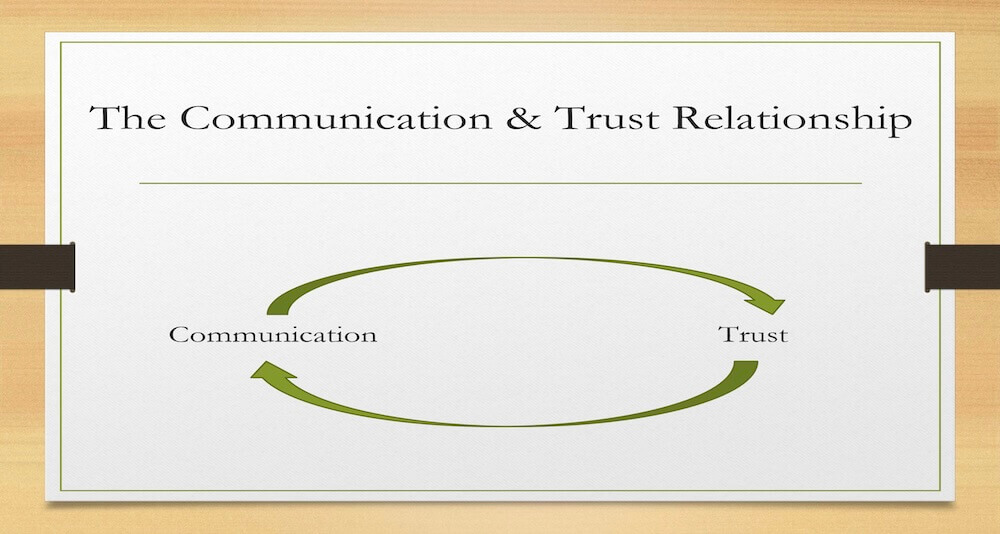
Trust leads to effective communication. Effective communication leads to trust.
To improve the level of trust in your relationship, you must first look at where your relationship is with respect to trust and communication. To do this, rate the level of trust in a relationship and the effectiveness of communication.
One reason relationships fall apart is that the participants in the relationship stop communicating with each other, or the communication may just be words without meaning to the person hearing what is being said.
How would you rate the level of trust in relationships you have on a scale of 1 to 10, with 1 being nonexistent trust up successively to 10 being exceptional trust? How many 4’s and 5’s did you rate your relationships, or were the numbers higher or lower?
Next, look at how you would rate the level of communication you have with the people or organizations you have a trust relationship with. Once again, on a scale of 1 to 10, how would you rate the communication in the relationships, with one being poor or nonexistent communication successively up to 10 being outstanding communication? More likely than not, the communication ratings will to a large degree correlate with the trust ratings.
Based on these simple ratings you have given your relationship, you can gain a perspective on how much trust is in the workplace and how successful communication works to build trust.
Here are a few questions to ask yourself:
- How important is it that employees trust you as a manager, the organization you lead, and the organization the employees work for?
- What are you willing to do to improve trust in the workplace?
- Do you believe trust by employees is overrated and doesn’t affect productivity?
It is quite clear that many federal employees have significantly less trust in the federal government as an institution and as an employer than they have had in past times. As an example, the federal government wants to take away things federal employees always thought they had as a part of the employment relationship.
Relationships between employees and their supervisors have also been fractured by management when an employee does not know from one day to the next whether they will continue to be employed. Relationships between unions and management in the federal sector have been placed under horrific stress by the extended use of an exemption for not allowing unions to exist.
Here are a few questions to ask yourself:
- Do employees work harder and are more effective if they believe they are working for a supervisor they can trust?
- Do employees work harder and are more effective if they believe they are working for an employer they can trust?
- Does trust in an employer lead to employees staying in their job longer than they might otherwise?
- Is the amount of money an employee is paid more important than the employee feels they are supported and respected by their employer?
- Would employees rather be paid more by an employer that they do not trust or paid less but believe in the organization they work for?
So how did you answer the questions? This short article cannot delve into all aspects of what trust means to you. There are so many ways that trust affects your life and has an impact on decisions you make, both in the workplace and in your personal life.
Conclusion
It is important to realize how trust affects so many relationships and the value of preserving trust or figuring a way to rebuild it if it is lost. A sizable portion of the work I have done involves working with labor and management in a unionized environment and internal management organizations on the dysfunction in their relationships. The lack of trust is often the preeminent problem dysfunctional relationships have.
The parties to a relationship can rebuild trust. From my experience in certain relationships, it may never fully be rebuilt but rebuilt enough to again be productive. It takes commitment, a deep belief in the need for a change, and a desire to do what needs to be done by all parties to the relationship. This all starts with a belief that trust is important, and if broken, it is worth the effort to fix the things that can be fixed to restore trust to the relationship.
In the business world, when the only issue in the minds of the leadership is the dollars and cents employees represent, the intangibles of the meaning of an effective relationship of management with employees get lost and are devalued. This can be the beginning of the loss of trust. When there is a trust deficit, it can be changed if both parties decide it is important.