

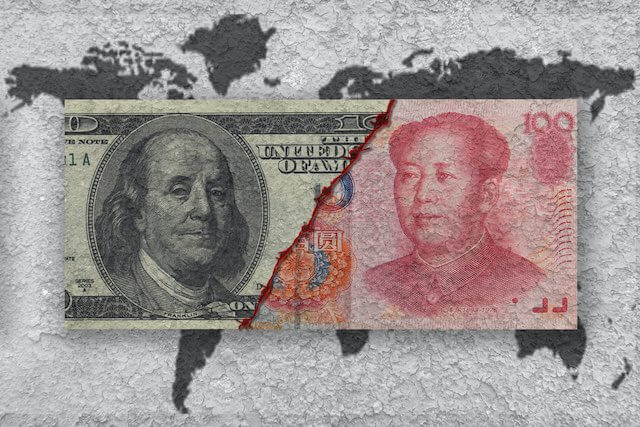
Recently introduced legislation would prohibit the Thrift Savings Plan (TSP) from investing in adversary nations such as China.
The TSP Fiduciary Security Act (H.R. 7357) was introduced by Congressman Randy Fine (R-FL). He said the legislation is a matter of national security, arguing that investments in adversarial nations “enhance the resources they need to not only compete with the United States, but develop weapons that can be used against our military.”
Key Provisions of the Legislation
If passed, the legislation would:
- Prevent investment in entities appearing on restricted lists maintained by the Departments of Defense and Commerce.
- Protect major industries from significant losses by including exceptions for the defense, emerging technology, and critical technology sectors.
- Prohibit TSP participants from investing in China-based companies through the TSP’s mutual fund window.
Fine said in a statement, “It is in the United States’ best interest to prevent the TSP from being invested in countries of concern, such as China. My bill would prevent excess funds from falling into the hands of our adversaries and stop them from being used to develop weapons that could be turned against the United States.”
Other countries specifically mentioned in the text of the legislation as currently written include Russia, North Korea, Iran, Syria, Sudan, Venezuela, and Cuba.
The I Fund and the FRTIB
Currently, the TSP’s I Fund does not have exposure to Chinese markets. It tracks the MSCI ACWI IMI ex USA ex China ex Hong Kong Index, a benchmark that specifically excludes China and Hong Kong from its emerging markets representation.
According to a fact sheet on the Index, it “captures large, mid and small cap representation across 21 of 23 Developed Markets (DM) countries (excluding the US & Hong Kong) and 23 of 24 Emerging Markets (EM) countries* (excluding China).”
The fact sheet also notes that the following countries are tracked by the Index:
- Developed markets countries: Australia, Austria, Belgium, Canada, Denmark, Finland, France, Germany, Ireland, Israel, Italy, Japan, the Netherlands, New Zealand, Norway, Portugal, Singapore, Spain, Sweden, Switzerland, and the UK.
- Emerging markets countries: Brazil, Chile, Colombia, Czech Republic, Egypt, Greece, Hungary, India, Indonesia, Korea, Kuwait, Malaysia, Mexico, Peru, Philippines, Poland, Qatar, Saudi Arabia, South Africa, Taiwan, Thailand, Turkey, and United Arab Emirates.
The exclusion of China from the I Fund’s index is a result of a policy decision made by the Federal Retirement Thrift Investment Board (FRTIB) rather than a requirement of federal law which is presumably why the legislation was introduced.
In 2019, the agency planned to change the index tracked by the I Fund to the MSCI All Country World ex-U.S. Investable Market (MSCI ACWI ex-US IMI) Index. That led to a lot of pushback from some lawmakers who said the change was a mistake because it allowed for TSP investments in Chinese companies.
After the controversy, the FRTIB ultimately decided to change the I Fund to track the index that excludes China. Without the passage of the TSP Fiduciary Security Act or similar legislation, the agency could theoretically decide to return to an index that includes Chinese equities or those from other countries deemed to be problematic to seek broader market diversification.
By codifying these restrictions, the bill would remove that discretionary power from the FRTIB, ensuring that the exclusion of countries deemed to be security risks to the United States remains a permanent fixture of the federal retirement system.