

It is likely true that no one really likes having to pay taxes to the federal government. Perhaps it is also true that the American public assumes federal employees or retirees will generally pay their taxes more diligently than others do.
Whether that is the case or not, federal policies, regulations, IRS/Treasury statements, and oversight reports are based on the premise that the public does expect (or at least should expect) federal employees to demonstrate higher tax compliance integrity. This expectation is framed as necessary to maintain public confidence in the tax system, precisely because federal employees’ salaries and pensions are funded by taxpayers.
According to the inspector general cited in the background section of a new report:
While all taxpayers have a responsibility to file appropriate tax returns and pay taxes as they become due, federal employees have a higher responsibility to satisfy in good faith their obligations as citizens, including all just financial obligations, especially those such as federal, state, or local taxes that are imposed by law.
Ethics in Government
Regulatory and ethical standards impose a higher duty on federal employees. Under Standards of Ethical Conduct for Employees of the Executive Branch, federal employees must “satisfy in good faith their obligations as citizens, including all just financial obligations, especially those such as federal, state, or local taxes that are imposed by law.” IRS guidance reinforces this, stating that agency leaders should promote tax compliance among federal employees “to maintain public confidence in government.”
The IRS and Treasury Inspector General for Tax Administration (TIGTA) cite this as a public expectation tied to taxpayer funding.
With this background, it may surprise some readers that a new report from TIGTA shows tax delinquency among federal employees and retirees has been rising, with now more than 571,000 current and retired federal workers owing approximately $6.3 billion in unpaid federal taxes.
The report, entitled Federal Employee and Retiree Trends Show Increased Tax Noncompliance, examines trends from fiscal year 2021 through fiscal year 2024 under the IRS’s Federal Employee/Retiree Delinquency Initiative (FERDI). The report concluded that delinquency rates among federal workers “steadily increased” during that period.
About 50,000 of these federal civilian employees failed to file tax returns in multiple years, and more than 1,000 failed to file returns at least 6 times during their careers.
Tax Debt Increased by $1.5 Billion
According to the report, the total unpaid tax balance owed by federal employees and retirees increased by more than $1.5 billion from Fiscal Year (FY) 2021 through FY 2024, a 32% increase.
At the same time:
- The total federal and retiree workforce declined by less than 1%
- The number of delinquent federal employees and retirees increased by 43%
- The delinquency rate for current federal civilian employees rose from 4.9% in FY 2021 to 6.9% in FY 2024
The report noted that approximately 50,000 current federal civilian employees failed to file tax returns for multiple years. The report identified 122 taxpayers who had not filed returns for eight or more years and referred those cases to IRS Criminal Investigation because Collection personnel had not done so.
Why Has Tax Noncompliance Increased?
IRS Collection management told IG investigators the increase was partly caused by enforcement disruptions during and after the COVID-19 pandemic. Specifically, the IRS temporarily suspended or slowed:
- Levy programs
- Collection notices
- The Automated Substitute for Return program used to pursue nonfilers
The IRS began restoring some enforcement efforts in August 2024 through a phased resumption of levy programs and expects delinquency rates to decline in future years.
The report also points to another major factor: privacy laws.
Under the Internal Revenue Code, the IRS generally cannot disclose an employee’s tax delinquency to that employee’s agency unless the employee works for the Department of the Treasury. The report argues that this limits agencies’ ability to hold workers accountable for unpaid taxes. And, apparently, there are a number that will not pay taxes if they can get away with keeping the taxes owed for their own personal use.
Treasury employees are an exception because the department is permitted to review employee tax compliance. The report noted Treasury’s delinquency rate was only 2.4%, substantially below the broader federal workforce rate. So, apparently, more vigorous enforcement is necessary to ensure that federal employees and retirees pay what is owed back to Uncle Sam in the form of income taxes.
The Treasury watchdog urges the IRS to revisit a prior recommendation seeking legislation that would allow agencies to receive limited information about employees with serious tax delinquencies.
IRS Sent 427,000 Warning Notices
In 2025, the IRS created a new notice—Letter LT36—to warn current and retired federal workers who have been identified as tax delinquent.
The IRS mailed approximately 427,000 notices between June and July 2025.
By August 2025:
- About 59,000 recipients had made payments
- Roughly 4,700 taxpayers fully paid their balances
- The IRS collected approximately $58 million after the notices were issued
IRS officials described the mailing as a “one-time” effort and indicated they do not expect to repeat it.
The report shows a substantial worsening trend compared to earlier reports like the current one. A 2023 review found that by FY 2021:
- About 149,000 federal civilian employees owed roughly $1.5 billion in unpaid taxes
- More than 42,000 employees repeatedly failed to file tax returns.
- More than 1,000 delinquent employees had been noncompliant for six years or longer.
The new report expands the scope to include retirees and military personnel and shows the number of delinquent federal employees and retirees has now grown to more than 571,000 with unpaid balances totaling $6.3 billion.
For current federal civilian employees alone, the IG found the delinquency population increased by more than 66,000 employees between FY 2021 and FY 2024, while unresolved balances rose by more than $664 million.
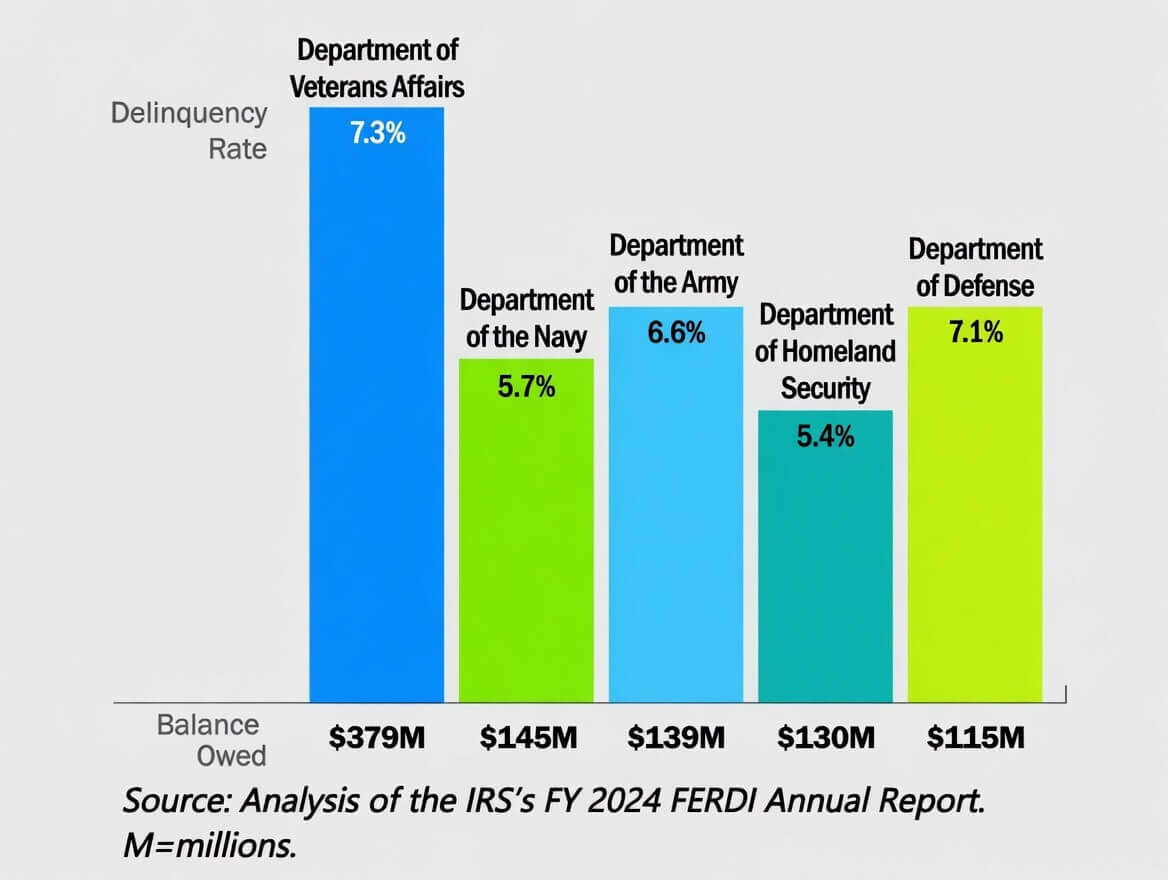
Agencies With the Highest Balances
Several agencies and departments have especially high unresolved tax balances, although the report emphasized these agencies also employ large portions of the federal workforce.
Here is a chart showing the top Executive Agencies with the largest amounts of unpaid taxes by employees.
Here is a chart showing the top five large independent agencies with the highest balances.
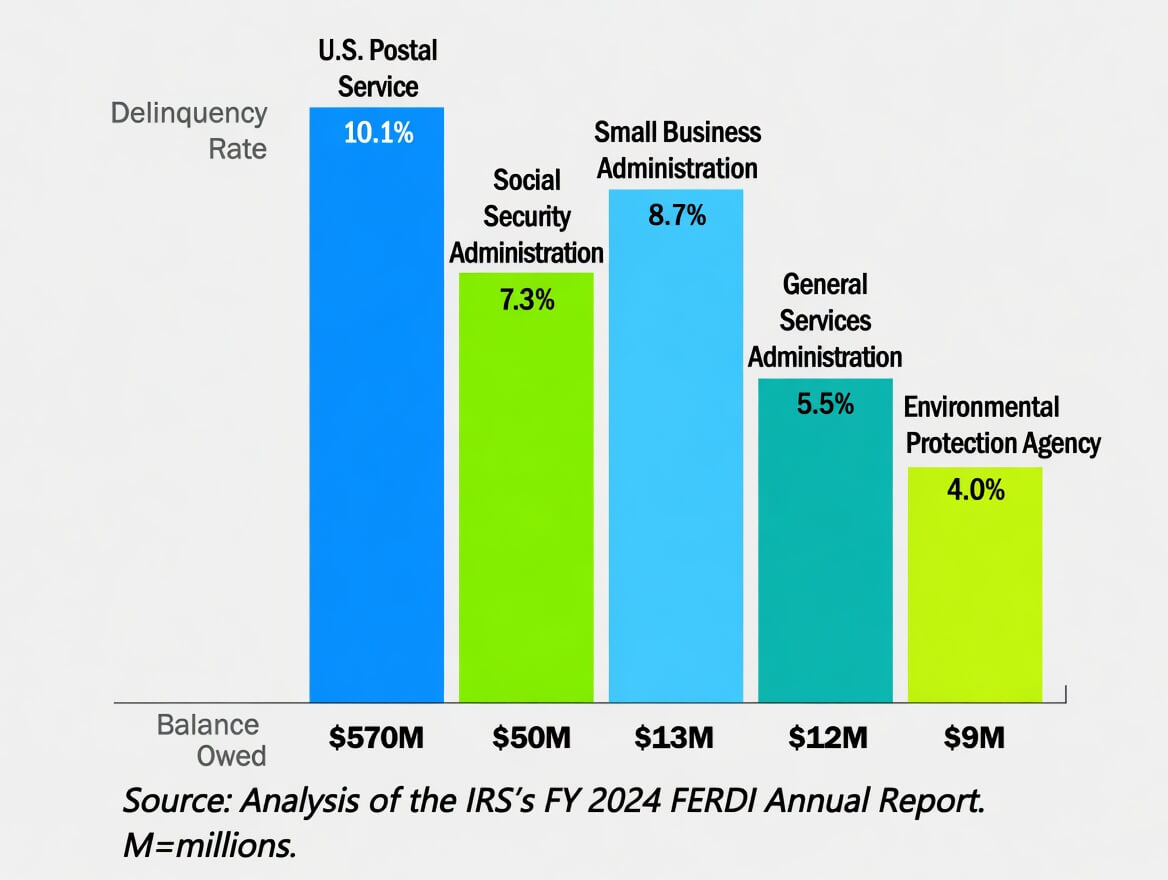
Among the other agencies highlighted were these large agencies which generally had a larger balance of unpaid taxes than the independent agencies.
- Department of Veterans Affairs
- Department of Defense
- United States Postal Service
- Department of Homeland Security
- Department of Justice
The Postal Service reportedly had the highest delinquency rate among the largest agencies examined, with roughly 10% of employees delinquent on their tax obligations.
The report notes that Senator Chuck Grassley (R-IA) sent a letter to the acting IRS commissioner in April 2025 expressing concern over the rising number of delinquent federal employees and retirees. He wrote that federal employees “have a heightened responsibility” to obey tax laws because their salaries and benefits are funded by taxpayers.
The report echoed that concern, warning that public awareness of widespread federal employee tax delinquency could undermine broader taxpayer compliance.
In short, it now appears that reducing the number of tax delinquents in the federal workforce and federal retiree community will require stronger enforcement measures, with measures imposed and publicized to reduce the growing number and amount of taxes owed to the federal government.