

Determining a pay raise, if any, for federal employees is a long, complex process. While President Trump recently issued an Executive Order for pay raises in 2026, the process to determine the 2027 pay raise (if any) will continue throughout 2026.
On December 18, 2025, the President’s Pay Agent issued its annual report. This report underscores a growing disconnect between federal pay law and federal pay reality. It also indicates that the Pay Agent will not be heavily influenced by Federal Salary Council recommendations for 2027.
The latest report is very different from the approach of past reports. It essentially rejects the Federal Salary Council’s suggestions and instead recommends restructuring the federal pay system—including modifying the Federal Salary Council (FSC) to include broader representation.
In January 2025, the FSC recommended a new locality pay area for the Kennewick-Richland-Walla Walla, Washington Combined Statistical Area (CSA) and the Syracuse-Auburn, NY CSA as new locality pay areas. It also recommended adding Wyandot County, OH, to the Columbus, OH, locality pay area and Yuma County, AZ, to the Phoenix, AZ, locality pay area. If accepted early in 2025, these could have gone into effect in 2026. That did not happen.
The Pay Agent’s annual report and its response to the FSC were issued on the same date as President Trump’s Executive Order setting forth the General Schedule pay plan for 2026. The Pay Agent did not accept the FSC recommendations. The Pay Agent report stated:
With respect to the recommendations in the Federal Salary Council’s report to change locality pay area boundaries, we do not approve of further additions to existing locality pay areas or the creation of new locality pay areas at this time. Approval of the locality pay area boundaries recommended by the Council in recent years has resulted in expansions of locality pay areas that do not align with geographic realities or labor market conditions.
While the statutory formula calls for double-digit locality pay increases to close the gap with private-sector wages, the Pay Agent has rejected that approach as fiscally unrealistic, as it has in the past. Instead, the report signals continued reliance on modest across-the-board raises, frozen locality rates, and an acknowledgment—rarely stated this plainly—that the General Schedule pay system is outdated and increasingly misaligned with today’s labor market.
The bureaucratic process for the 2026 pay raise has now been completed, and the new pay raise is effective in January. The process for the 2027 federal pay raise will play out throughout the year.
What the Pay Agent Report Is and Why It Matters
The President’s Pay Agent (Secretary of Labor, Director of OMB, and Director of OPM) is required under federal law (5 U.S.C. § 5304) to report annually to the President on locality-based comparability payments — the geographic pay differentials designed to keep General Schedule (GS) pay competitive with local non-federal labor markets.
The report compares federal and non-federal pay, identifies pay disparities by locality, and generally recommends adjustments to close those gaps. It also includes views from the Federal Salary Council and employee organizations.
The difference in this report is that the Pay Agent recommends how to restructure the pay system to reflect the structure and jobs performed by federal employees today rather than the workforce from about 1950. It does not go through a detailed analysis of the FSC recommendations. It essentially dismissed the FSC recommendations out of hand.
According to the Pay Agent:
The pay disparities the Council reports each year emerge from a deeply complex and excessively resource-intensive methodology that has been widely recognized as flawed ever since its inception in the early 1990s. Decades of historical data used in the locality pay program reflect a methodology that produces implausible results while ignoring occupational realities, mission needs, and performance considerations.
NARFE Recommendation for 3.8% Raise
The National Active and Retired Federal Employees Association is not a federal employee union, but it often proposes policies similar to those of federal employee unions regarding federal employee pay and benefits. For the 2027 federal pay raise, NARFE National President William Shackelford issued the following proposal in a press release:
Without adequate staffing, federal government operations and services on behalf of the American people will suffer. I urge Congress to pass at least a 3.8% market-rate federal pay increase, in line with recent private sector pay increases and the increase to military pay rates and for federal law enforcement. With the federal government having 300,000 fewer federal workers by the start of next year, those remaining will be asked to fulfill their missions with less support. They should be compensated appropriately.
Any prediction about the final figure for a pay raise in 2027 is just a guess. It could end up being 3.8% if President Trump determined this was the appropriate raise or if Congress passed legislation for that amount.
The problem with the NARFE proposal is that it does not address the shortcomings highlighted by the Pay Agent’s report. The current system always has interest groups or Congressional representatives with large federal employee populations arguing for a higher raise and advancing arguments similar to those highlighted by NARFE.
These are some of the arguments raised by the Pay Agent that are not generally addressed by organizations that routinely argue for a higher pay raise:
- Assessing the total compensation gap. In addition to comparing Federal and non-Federal salaries, develop a method to compare the costs of major benefits, such as health insurance and pensions, to assess disparities in total Federal and non-Federal compensation. Such a method could be part of a comprehensive, periodic review of total compensation for white-collar Federal civilians, possibly through the creation of a commission with broader representation than the current Federal Salary Council.
- Providing different pay ranges for different occupations. As noted in many Pay Agent reports, the current GS system uses a process that requires a single percentage adjustment to the pay of all white-collar civilian Federal employees in each locality pay area, without regard to the differing labor markets for major occupational groups. The Federal Government needs to address this decades-old flaw with a system that reflects labor market realities rather than, for example, proceeding year after year as if the overall labor market sees no difference between high-stakes cybersecurity work and routine financial accounting.
- Eliminating GS steps and creating an open range for each grade or work level, and making meaningful pay distinctions based on performance. The existing GS pay system rewards longevity over performance. Eliminate automatic pay increases within rate ranges, and vary any increases provided based on performance to ensure meaningful pay distinctions for the best employees.
- Locality pay areas have grown too large and no longer reflect current labor markets. A contributing factor: The Salary Council is largely composed of federal employee unions and routinely urges significant pay raises for federal employees, a heavily unionized workforce, and the unions have little interest in modifying the pay areas into areas that may reflect current labor markets.
- Pay Agent rejects further tweaking of local boundary lines under the current statutory methodology.
Here is a graphic displaying the locality pay area for the Washington, DC-Baltimore area:
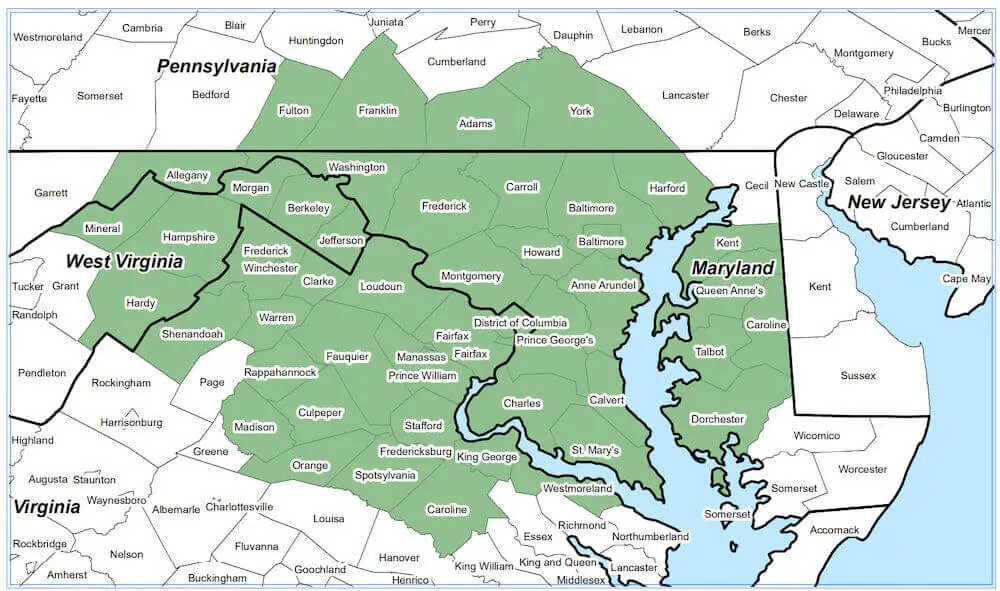
These changes would require some legislative action. The reality is that there is a vested interest in maintaining the current system and in making the argument each year that federal employees are dramatically underpaid compared to the private sector. Perhaps that is true, but there is obviously skepticism and no desire to make these changes among organizations whose support could result in a more accurate process for the annual pay raise determination.
What This Means for Federal Employees
- No major locality pay increases for 2026. Locality pay stays at 2025 levels.
- A modest 1% base raise for most GS employees — with possible extra adjustments for select law enforcement roles.
- There is a growing debate over whether the current GS/locality pay framework actually serves recruitment, retention, and market competitiveness goals.
- Based on the Pay Agent’s latest report, unless there are legislative changes, the process for determining the 2027 pay raise for federal employees will be similar to last year’s.
Why This Matters in the Broader Pay Debate
The Pay Agent report underlines the persistent gap between statutory pay comparability requirements and practical pay policy choices. If the statutory formula were applied in 2026, locality pay for 2026 would average nearly 18.9% based on pay disparities calculated from Bureau of Labor Statistics (BLS) data.
This sends a clear signal: the existing system is increasingly strained.
As a result, presidents routinely invoke an “alternative pay plan,” overriding the statutory formula. For employees, that means:
- Locality pay rates effectively frozen
- Small, uniform base raises instead of targeted market corrections
- A widening gap between what the law promises and what pay policy delivers.
That is likely to happen again for the 2027 pay raise.
The most likely outcome for 2027: The Federal Salary Council will issue a report making changes to add or enlarge locality pay areas, President Trump will propose an alternative pay plan, the Pay Agent will ignore the FSC recommendations, and changes similar to the system for determining the pay raise, the alternative pay plan will be implemented unless Congress inserts a different figure in a large, comprehensive bill that gets passed by Congress.
The reality is that there will likely be an overall average pay raise of 2%-3%, depending on inflation, the state of the economy, the budget deficit, and what happens in the mid-term elections.